
Find Brooklyn Residents Through Records
A useful Brooklyn residents directory search begins by matching the question to the kind of record that can answer it. A current street address points first to the NYC Department of Finance property system and the parcel identifier it returns. A recorded transfer, mortgage, lien, or party address belongs in the City Register index. A historical household belongs in a dated directory, census, newspaper, or archive collection. A court result can identify a case party, not confirm a present address. Keeping each role separate makes the result more reliable.
There is no one public roll for every Brooklyn household. Parcel systems name owners or entities, filings name parties, and historic books often list a head of household. The official voter tool is a tightly limited match service rather than a street browse. Use the date, exact spelling, address, BBL, BIN, and record role together before treating two entries as the same person.
- Roll
- A list or register created for a defined official purpose, not a complete list of all Brooklyn households.
- Index
- A finding tool that points to a record, such as an ACRIS document, rather than the full proof by itself.
- Criss-cross directory
- A dated reverse directory that starts with a street address and can identify a listed historical name.
- Parcel
- A mapped property unit, usually connected across Brooklyn systems by its borough, block, and lot identifier.
- Enter a known Brooklyn address in the property portal and save the returned BBL, the borough-block-lot key.
- Use that BBL in the City Register index to inspect recorded property documents and dates.
- For a known individual, use the Board of Elections matcher only with the required identity fields and read a match as registration confirmation.
- For an earlier period, compare dated directories and census material held by Brooklyn libraries and archives.
- When an online result ends, ask the named custodian for its existing file, index, microfilm, reading-room material, or a properly described FOIL record.
Brooklyn Resident Records Offices
Brooklyn uses citywide New York City record custodians alongside Kings County court offices. The City Register records real-property documents for Brooklyn, while the NYC Department of Finance property portal supplies a parcel view and the Board of Elections provides a limited registration check. The Kings County Clerk holds Supreme Court records and certifications. Each office answers a different question, so an owner, a filing party, and a court party should never be treated as interchangeable evidence of residence.
NYC Board of Elections
345 Adams Street, 4th Floor
Brooklyn, NY 11201
718-797-8800
For Supreme Court files, the Kings County Clerk maintains the court-side route. It is distinct from the City Register, even where a matter involves Brooklyn real property.
Brooklyn Addresses Begin With BBL
Brooklyn records connect more cleanly once an address has a BBL and, when available, a BIN. BBL means borough, block, and lot. The property address is the situs, or physical parcel location. A BIN is a building identification number. These identifiers help reconcile a modern address with Finance, ACRIS, DOB, HPD, ZoLa, and map records. They also prevent a common error: assuming an owner mailing line identifies the person at the street address.
The Finance card can show owner, tax class, building and land characteristics, assessments, exemptions, neighborhood geography, and recent sales or recording summaries. Some values may be blank or stale. A cooperative, condominium, air lot, or subterranean lot can introduce more than one parcel relationship. Preserve the returned identifier and the date inspected, then use the official recorded index for a title question.
The NYC Finance parcel-card view illustrates the record categories that follow a Brooklyn parcel.
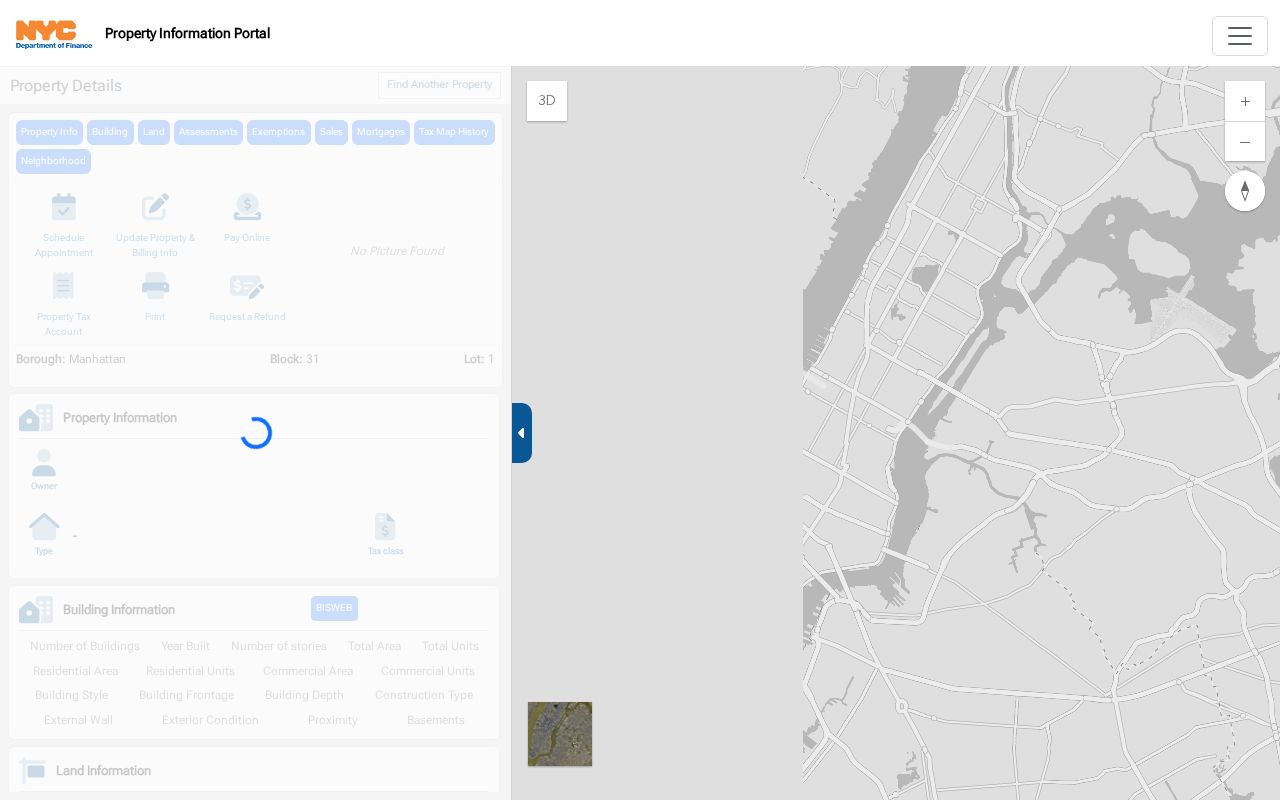
The card is a strong starting point for a parcel trail, but its owner and mailing fields remain property evidence, not a complete list of residents.
Brooklyn Property Portal Search Paths
The NYC Property Information Portal is address and parcel driven. Its primary public form does not offer owner name as its main path. Use a street number and street name, an intersection or common place, or the BBL route. It also has paths for borough and block, condominium number, co-op development number, REUC identifier, open tax accounts, air lots, and subterranean lots. A failed BBL can mean a wrong format, a changed lot, or no tax-map match.
The PIP Find a Property form is the practical opening for an address-led Brooklyn residents directory search.
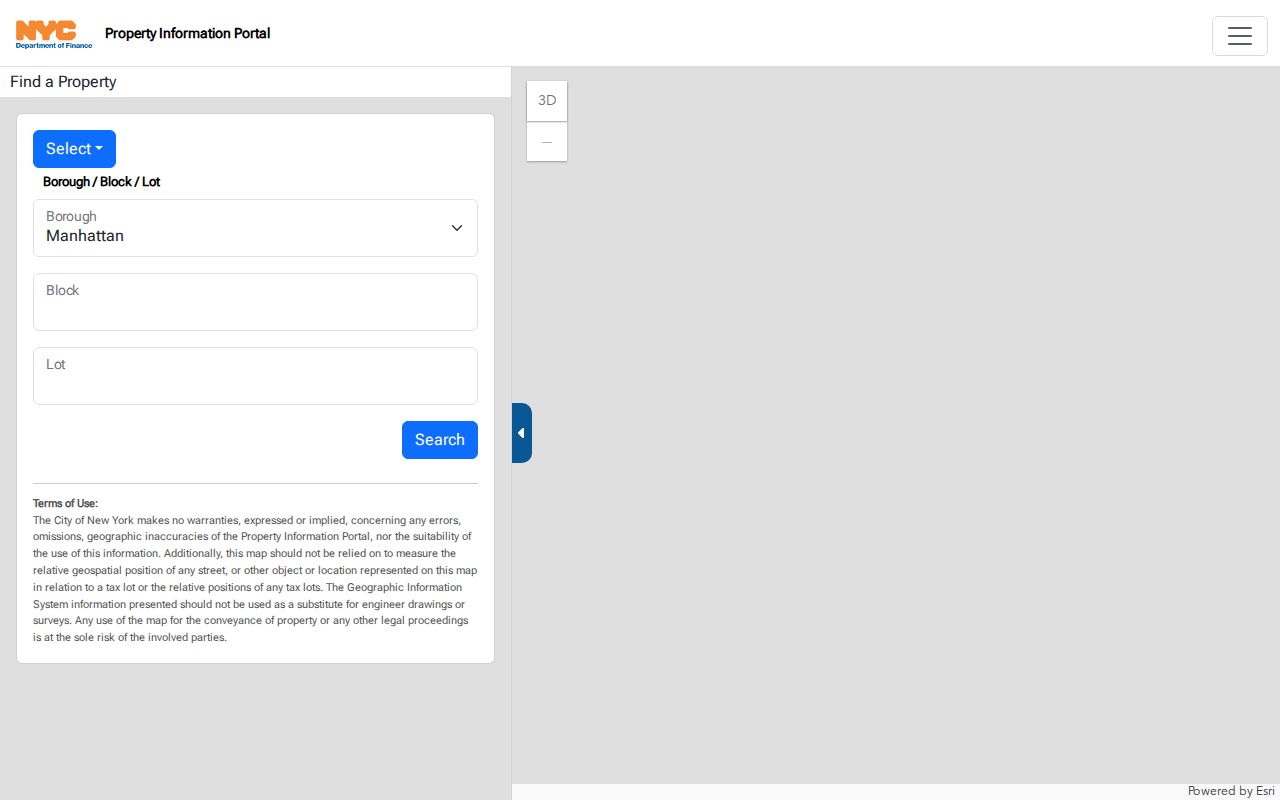
Its separate search tiles show why a standardized address or BBL should be retained before moving to documents, building systems, or map layers.
| PIP field or mode | Input | When it helps |
|---|---|---|
| Address | Street number and name | Known street address, intersection, or common place |
| Borough, Block, Lot | Borough selector and numeric keys | A parcel already identified on a map or deed |
| Borough and Block | Borough selector and block | Block-level parcel work before selecting a lot |
| Condo or co-op mode | Borough plus development identifier | Property records that do not behave like a standard lot |
| Air or subterranean lot | Borough, block, and special lot input | Unusual parcel arrangements needing their own record path |
Brooklyn ACRIS Recorded Party Trail
ACRIS is the City Register’s central property index for Brooklyn, Manhattan, Queens, and the Bronx. Brooklyn’s online real-property coverage begins in 1966. Search by party name, BBL, document type, document ID or CRFN, transaction number, reel and page, or a UCC or federal-lien file number. The address-to-BBL bridge is useful before a parcel search. For a person, search grantor and grantee roles separately and test initials, entity names, prior names, and date ranges.
A result can include the document ID, page count, document type, execution and recording dates, amount when applicable, parties and their listed addresses, parcels, references, and remarks. The online image is useful when available, but the entry still needs context. A later correction deed, estate transfer, or recorded satisfaction can change what a first result seems to mean.
ACRIS presents the property-record entry choices used to move from a Brooklyn parcel to a dated document trail.
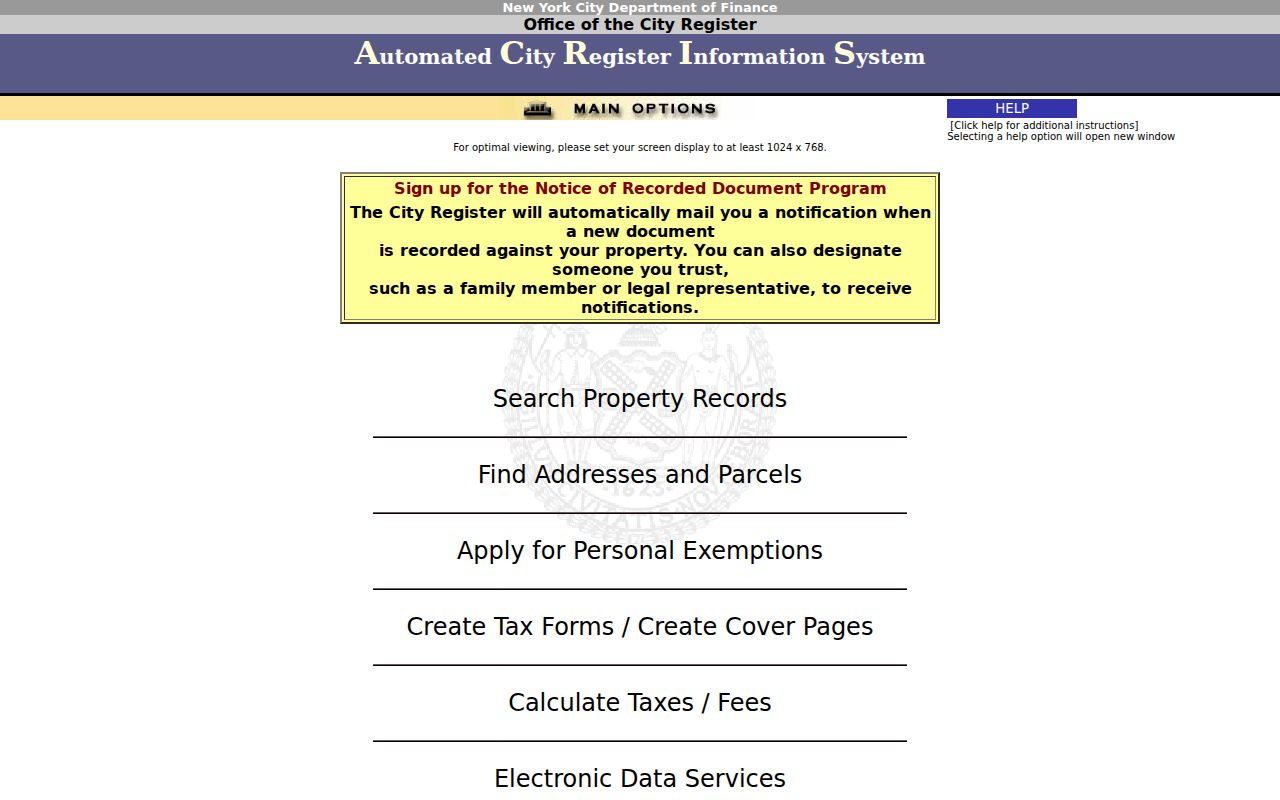
The index is free to search. Images and prints may also be available online or through a Public Access Terminal, while older records require City Register books, indexes, microfilm, or historical collections.
Brooklyn Voter Match Boundaries
The NYC Board of Elections Registered Voter Search is a name-and-status confirmation tool. It requires first name, last name, birth date, borough, and ZIP Code. Select Brooklyn for a Brooklyn record and use the name exactly as registered. The returned result is a match or a record-not-found response. It is not a public street roster, and it does not display a person’s ballot choices or broad participation history.
The Board of Elections matcher visibly requires all five fields before it can check a Brooklyn registration record.
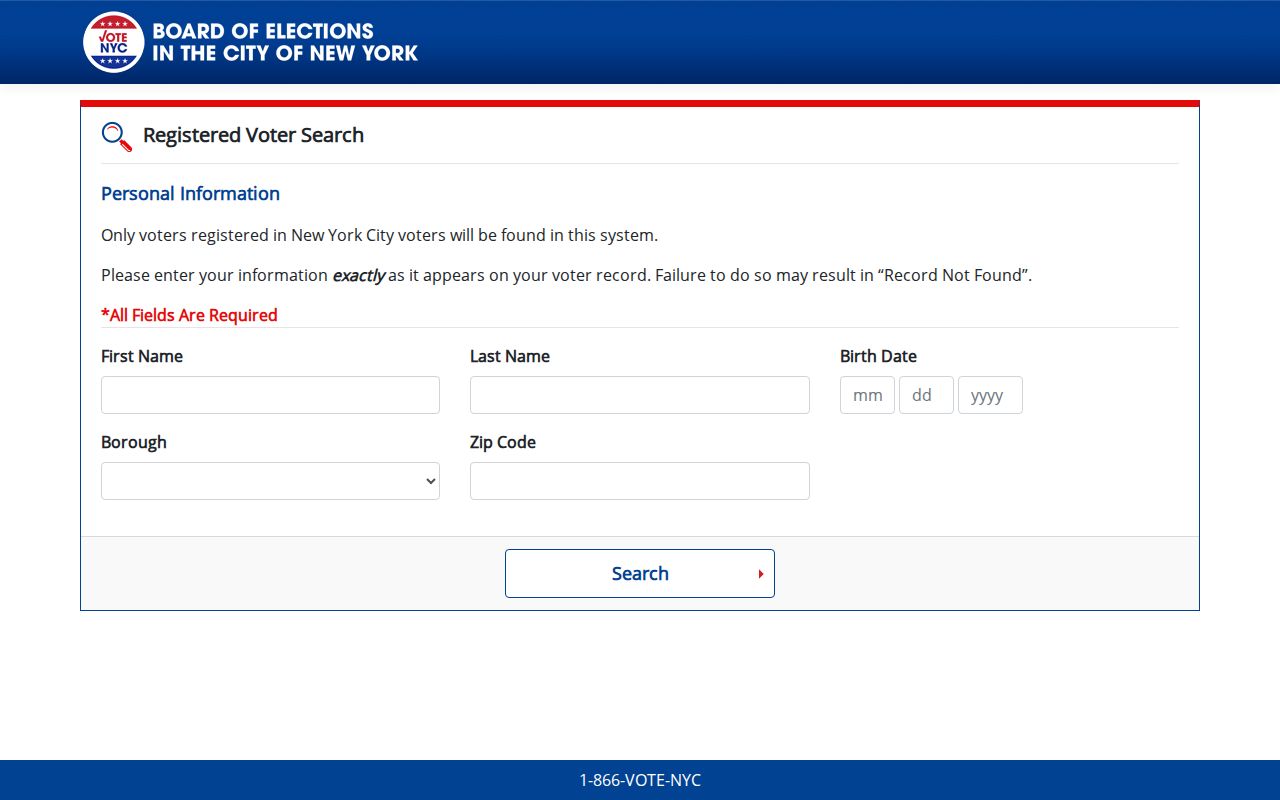
A name mismatch may be a spelling, birth-date, borough, or ZIP issue. It should not be used to conclude that someone does not live in Brooklyn or is not registered.
New York’s full voter-file route is different. A request must state an elections purpose under Election Law §3-103(5), and protected or confidential voters require special treatment. That limit matters whenever an address-led search seems to promise more than the public form actually returns.
Brooklyn Current Residents Directory Sources
Current Brooklyn directory evidence is distributed among record systems. The Finance portal is strongest for a parcel and recorded owner or entity. ACRIS is strongest for recorded property parties and instrument history. The voter matcher confirms only an exact individual registration combination. DOB and HPD provide building and filing evidence. Public office contact pages can verify an official role, but no single citywide Brooklyn resident list was located in the research.
| Brooklyn source | Identity or address signal | Keeper | Access boundary |
|---|---|---|---|
| PIP parcel card | Owner or entity, BBL, parcel facts | NYC Finance | Free address and parcel portal |
| ACRIS | Recorded grantor, grantee, and filing addresses | NYC City Register | Free index, images or print route |
| Voter matcher | Registration match for exact required fields | NYC Board of Elections | No public street browse |
| DOB and HPD records | Applicant, owner, agent, or building record role | NYC Buildings and HPD | Address or BBL search, role is not occupancy |
| Public organization contacts | Office and community contact information | Community boards and agencies | Public contacts, not household lists |
The official route has a clear provenance and a defined record role. Commercial people-finder services may combine older or mismatched data without showing how it was obtained, so their categories should never replace a custodian record. For a single individual, the Brooklyn resident lookup page takes a more focused verification route.
| Official record route | Commercial category |
|---|---|
| Names the custodian, record type, date, and access limit. | May combine sources with unclear timing or matching rules. |
| Lets the reader inspect the parcel, filing, or archive context. | May not show the underlying source or its limits. |
Brooklyn Court Index Routes
The New York State Unified Court System eCourts services are index tools, not a universal case file cabinet. WebCivil Supreme can search by party name, index number, attorney, justice, court, filing year, and case status. WebCivil Local, WebCriminal, WebFamily, and WebSurrogate each have their own scope. A Brooklyn result may identify a party role, case number, court, filing status, or calendar information, but it does not by itself establish a current address or confirm that two similar names are one person.
Save the exact court, term, party role, case number, status, and search date. Then use the clerk or record room for available papers. Kings Civil Court has public terminals and archive channels, while Kings County Clerk maintains the Supreme Court record route. Restricted family, adoption, sealed, and protected matters do not become public merely because a related index exists.
Brooklyn Vital Record Custody Split
Brooklyn birth, death, and marriage research depends on the period and event type. NYC Health issues recent Brooklyn birth and death certificates under eligibility rules. The NYC City Clerk handles later NYC marriage records. The Municipal Archives holds historical Brooklyn births from 1866 to 1909, deaths from 1847 to 1853 and 1857 to 1948, and marriages from 1866 to 1949. Historical Vital Records NYC supports search and browse by certificate type, name, borough, year, or certificate number for the material it has digitized.
An online absence is not a final answer. The historical service adds records over time, and a researcher may need the holdings guide, a staff search, an order form, or an archive appointment. Recent records are not available through FOIL when a separate confidentiality and eligibility law controls access. That distinction protects the record and avoids sending a request to the wrong agency.
Brooklyn Historical Resident Directories
Brooklyn’s historical directories are a shelf of overlapping sources, not one continuous list. BPL and the Center for Brooklyn History hold early, residential, telephone, elite, Blue Book, and reverse-address material. The Center’s address books cover 1929 to 1931, 1933 to 1961, 1963 to 1970, 1972 to 1980, and 1986. Those gaps are real. The standard directories are commonly alphabetical, while the criss-cross volumes are the better tool for an address in their covered years.
For pre-1950 material, contact the Center for Brooklyn History at 128 Pierrepont Street. Later directory holdings are at Brooklyn Public Library’s Central Library at 10 Grand Army Plaza. The books are noncirculating, and some microfilm is offsite. Library of Congress scans, DORIS holdings, NYPL collections, newspapers, maps, and census records can provide a second dated check. The fuller collection detail belongs on the Brooklyn city directory page.
Brooklyn Records Beyond Online Search
When an index ends, Brooklyn offers several documented fallback channels. The City Register’s older books, liber and page references, and microfilm fill part of the period before online ACRIS. Kings County Clerk and court counters handle case and certification routes. DORIS research rooms and the Municipal Library hold historical records, maps, reports, and vertical files. BPL and NYPL supply directories, microfilm, local newspapers, and older conveyance indexes. A file may need advance notice or a reading-room visit.
FOIL is a way to request an existing agency record, not a request for a new directory. Under New York Freedom of Information Law, Public Officers Law Article 6, an agency generally responds within five business days by granting, denying, or acknowledging the request with an approximate date. Describe the existing material by address, BBL, date range, file number, or office unit. Paper copies can generally cost up to $0.25 per page for the stated size, while electronic or oversized production follows the applicable actual-cost rules.
Brooklyn Property Records Across Centuries
Brooklyn’s property trail has a useful numerical boundary. ACRIS gives online access to Brooklyn real-property records from 1966 forward. Before that point, City Register books, liber and page indexes, microfilm, NYPL conveyance material, and the Center for Brooklyn History’s Brooklyn Land Conveyance Collection take over. The BPL abstracts are organized by block, identify grantors and grantees, and reach from 1699 to 1896. They are abstracts rather than the underlying deed, so they should be cited as that kind of evidence.
This long split explains why a recent parcel search can be quick while a nineteenth-century transfer takes several repositories. It also makes a BBL, legal description, alternate street number, and document reference more valuable than a name alone. Note: ACRIS results are an index to recorded material, and older routes may require staff help, microfilm, or a reading-room appointment.
Brooklyn Records After Consolidation
Brooklyn joined Greater New York on January 1, 1898, and Kings County became coterminous with the borough. That history explains why an earlier record may refer to Flatbush, Gravesend, New Utrecht, Flatlands, New Lots, or the City of Brooklyn rather than the present borough label. It also explains the division between citywide agency portals and Kings County court custody. Search the historical jurisdiction as well as the modern name when a nineteenth-century record does not appear under Brooklyn.
Many address numbers changed around 1871 and 1872. Compare a printed address with an atlas, tax map, adjacent streets, ward or town reference, and legal lot description before deciding a historical entry refers to a different place. That patient comparison is especially important in a borough where directories, property books, and maps can describe the same location in different terms.