
Brooklyn Resident Lookup Record Paths
Choose the record that answers the precise question. Property and deed records can connect a person or entity with a parcel. A voter result confirms only a match to the exact fields entered. Court results identify a party and case information, while a historical vital index records an event rather than a current address. A careful Brooklyn resident lookup keeps those roles separate and saves each record's date and stable identifier.
| Record | What It Confirms | Where | Access |
|---|---|---|---|
| Property and deed record | Recorded owner or party, BBL, parcel, and document connection | NYC Property Information Portal and ACRIS | Public online; Brooklyn ACRIS documents are online from 1966 forward |
| Voter registration match | An exact name, date-of-birth, borough, and ZIP match | NYC Board of Elections | All five fields required; no street browse |
| Court index | Party role, case or index number, court, and status information | New York eCourts | Public index route; file and copy rules vary |
| Historical vital index | A dated Brooklyn birth, death, or marriage event in a covered run | NYC Historical Vital Records | Research images and custodian-specific copy routes |
| License or entity filing | A credential or business affiliation with the listed filing role | NYS Licensee Search and DOS records | Public search, but not residence proof |
Start with a known address in the Property Information Portal, then use its borough-block-lot number, or BBL, to locate the recorded document trail in ACRIS. ACRIS's online Brooklyn documents begin in 1966; earlier deed research shifts to City Register older-property books, historical indexes, and staff-assisted library or archive routes. Start with a name in ACRIS, the voter matcher, eCourts, license, and historical sources separately. An owner, grantee, filer, or party label is narrower than the word resident.
Brooklyn Resident Lookup in the Voter Tool
NYC's public voter tool is an individual match screen, not a list of people on a street. It requires first name, last name, birth date, borough, and five-digit ZIP. Enter the name as it appears in the record, select Brooklyn, and treat a match or record-not-found result as limited to the fields submitted. The screen does not display a public participation history or a block roster.
| First and last name | Both are required and should match the voter record as closely as possible. |
|---|---|
| Birth date | Month, day, and year are required fields for the match. |
| Borough and ZIP | Select Brooklyn and enter the five-digit ZIP associated with the record. |
| Result | The inspected tool returns a match or Record Not Found, not a public profile. |
The NYC Registered Voter Search shows the required fields used for this limited confirmation.
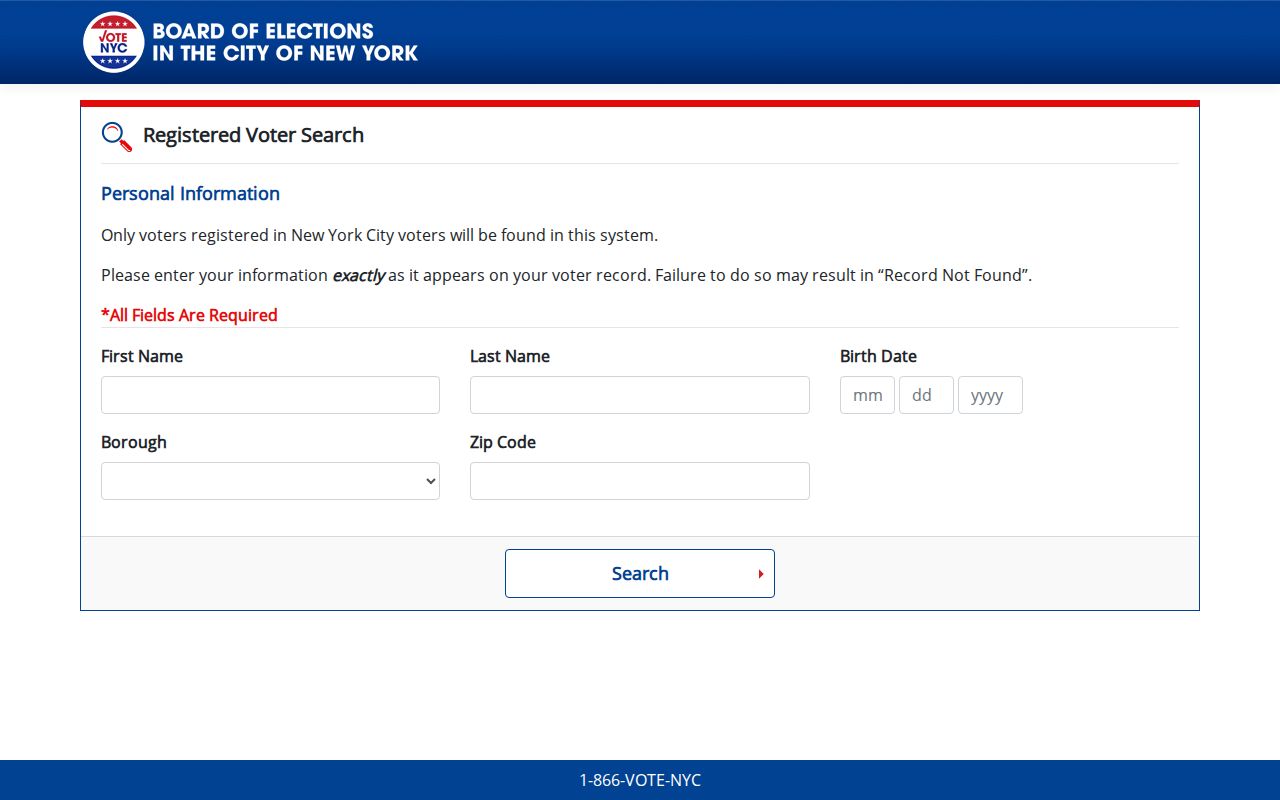
The form's field requirements make same-name checks possible, but do not turn it into proof of an address or a complete record. A full voter file is a separate FOIL route that requires an elections purpose under Election Law section 3-103(5); it is not a request for a new street list. Protected and confidential voters are not an ordinary public match source.
Brooklyn eCourts Party Results
New York State Unified Court System eCourts is an index service. WebCivil Supreme searches active and disposed civil Supreme cases by index number, party, attorney or firm, and justice. WebCivil Local, WebCriminal, WebFamily, and WebSurrogate have separate scope and access limits. A party-name hit can be a useful identity anchor only after the exact court, role, year, and case number are compared with another source.
| Party name and role | Shows how the indexed person appears, such as plaintiff, petitioner, defendant, respondent, or another role. |
|---|---|
| Index or case number | The stable number to save before asking a clerk about the file. |
| Court and filing year | Separates similarly named parties and directs the request to the proper clerk. |
| Status or appearance | Procedural index information, not a complete finding about the case. |
Case papers may be in NYSCEF when electronically filed, while non-electronic and archived material goes through the court or clerk. Kings Supreme Civil and the Kings County Clerk use 360 Adams Street; Kings Civil Court has public terminals and an archives route at 141 Livingston Street. Sealed, juvenile, adoption, and other restricted material remains unavailable through an ordinary name search.
Note: Save the court, party role, index number, filing date, status, and search date before requesting any case record.
Verify a Brooklyn Resident Match
Use two independent anchors before deciding that records concern the same person. A middle initial, name variant, spouse or parent name, old address, BBL, business entity, court role, or obituary date can distinguish a common name. The strongest statement names the actual record role and date, such as a recorded owner in an inspected deed or a historical directory entry in a stated year. It does not convert a filing connection into a current residence claim.
- Define the question and collect two identifiers, such as a full name plus address or an approximate age and year.
- For an address, use PIP or ZoLa to capture the BBL, then inspect ACRIS for the recorded parties and document dates.
- Search the person in the voter matcher, eCourts, historical vital index, and a license or entity source only where the record type fits.
- Compare middle initials, spelling variants, dates, roles, addresses, and identifiers. Test maiden, married, shortened, hyphenated, and apostrophe-free forms where relevant.
- Ask the named custodian a narrow question using the BBL, CRFN, index number, certificate number, or license UID rather than requesting a compiled people list.
- Docket
- A court's chronological case record, usually reached through its case or index number.
- Index versus image
- An index points to a record; an image is the scanned document or certificate page, which can have separate access rules.
- Certified copy
- A custodian-issued copy with the certification required for the purpose allowed by that custodian.
For annual historical name-and-address evidence, use the collection detail on the Brooklyn City Directory rather than assuming a present-day match.
Brooklyn Resident Lookup Vital Records
Vital records are divided by event type and time period. NYC Municipal Archives and Historical Vital Records cover Brooklyn births from 1866-1909, deaths from 1847-1853 and 1857-1948, and marriages from 1866-1949. The historical portal allows search or browse by certificate type, surname, borough, year, or certificate number where the selected search mode permits it. Its research images are useful for a dated event, but absence from the online portion calls for the holdings, order-form, appointment, or staff-search route.
For more recent events, NYC Health handles Brooklyn births after 1909 and deaths after 1950 under eligibility and identification rules. The NYC City Clerk is the route for post-1949 NYC marriages, with access governed by its relationship, proper-purpose, and other documented rules. Vital records are not opened by a general FOIL request. Use the agency's online, mail, or in-person channel that fits the record and eligibility requirement.
The NYC genealogy page explains the historical-custodian boundary and links to the Municipal Archives route. A historic index identifies an event; a certified copy is a separate request governed by the custodian's rules.
Brooklyn's Adoption Registry Path
Adoption records are sealed. For an eligible adult adoptee or birth relative seeking authorized non-identifying information or a mutual-consent reunion path, the New York State Adoption Information Registry is the official route. It is not a public name-search substitute, and a court or other restricted record does not become public because a related name appears in another index.
The registry is the appropriate channel for this personal family-history use because it preserves the confidentiality rules around adoption records. Retain the program's current eligibility instructions and use its process instead of attempting to infer protected identities from other sources.
Brooklyn Resident Lookup Licenses and Entities
New York license and entity records can provide a second identity anchor, but they describe a credential, business, service-of-process, or filing relationship rather than a home. The NYS Department of State Licensee Search accepts individual name, license type, county, city, and ZIP fields for active-license research. Record the license type, UID, status, and expiration date when available. A no-result can reflect an inactive file, a different agency, or a category moved to another state portal.
The state business-entity database can show an entity's current name, organization date, jurisdiction, county, service address, registered agent, status, and some officer or principal-location information. Older inactive entity files may require a written request. Kings County Clerk business certificates are a separate local route. Treat a service or business address as a filing address unless another official record independently supports a different conclusion.
Note: Preserve the license UID or entity filing detail as the source identifier, then label the result by its documented role.
FOIL Limits for a Brooklyn Resident Lookup
New York Freedom of Information Law, or FOIL, is a request path for an existing agency record. Under Public Officers Law Article 6, especially sections 87-89, an agency generally grants, denies, or acknowledges a request with an approximate date within five business days. A focused request identifies the custodian, record type, date range, borough or case geography, and any stable number already found. It should not ask the agency to create a universal resident list.
The New York FOIL guidance explains request and appeal procedures. Paper copies are generally up to $0.25 per page up to 9 by 14 inches, while some electronic or oversized production follows actual-cost rules. FOIL does not override a vital-record restriction, court seal, Election Law voter-file limit, ACP protection, or another specific confidentiality law.
Brooklyn Resident Lookup Safety Limits
New York has no universal public record that lists every current resident. Utility accounts and personal motor-vehicle addresses are not a general lookup route. The New York State Address Confidentiality Program uses a substitute address for qualifying participants, while confidential voter procedures protect voter information. A missing result may reflect a protected record, a sealed file, a name variant, an unindexed year, or the fact that another office holds the record.
If an official entry is wrong, take the record number to the named custodian and ask about its correction, amendment, reconsideration, or appeal process. A FOIL request does not itself amend an entry. Never try to reconstruct an ACP participant's location from nearby data or a substitute address.
Lawful personal use. Use public records for lawful personal, family-history, civic, or safety research. Do not use any result to stalk, harass, intimidate, or harm another person.